What are Education Systems in Different Countries
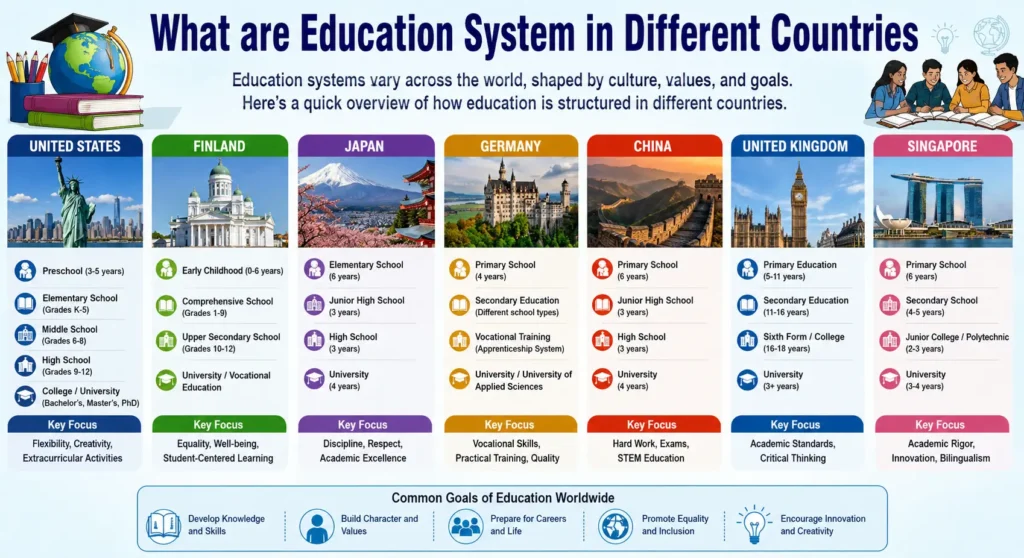
Education Systems can tell us a lot about a country’s history, its culture, its economy, and its social values. Even though a country may want the same outcome for its students as every other country, how they accomplish this differs greatly. Some countries may value discipline and hard work the most, while others may place more value on creativity and practical and/or experiential learning.
Education systems tell us a lot about a country’s ability to create a skilled workforce and its inclination to develop innovative ideas and prepare the next generations. This guide will help explain what education systems are, how education systems vary across the world, the most notable education systems and models, and the highest performing education systems.
Education Systems
Countries typically have a division of education into:
– Early Childhood Education
– Primary Education
– Secondary Education
– Higher Education
– Vocational and Technical Education
Each of these divisions varies from country to country regarding the length, what is taught, how they assess learning, and how they grade. Governments manage public institutions, but private institutions usually operate independently within the framework.
Education Systems of the USA
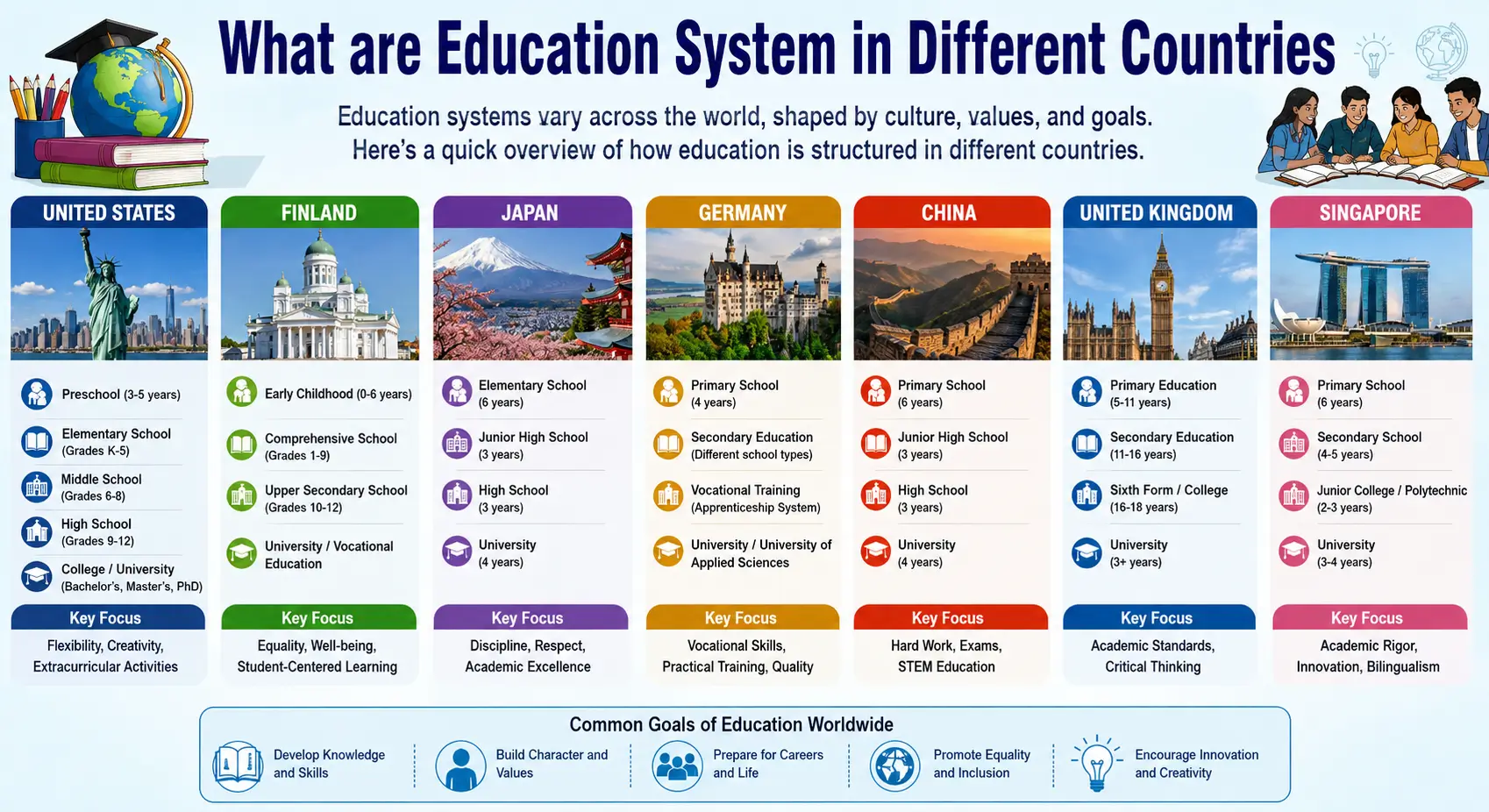
The USA is one of the most diverse and flexible education systems in the world. Education is mostly a state and local matter. It is not federally controlled.
Why Finland’s System is Most Successful
Finland’s education believes in equal educational opportunity for all children. Their education model strives for academic accomplishment while also focusing on personal development.
Education System in Japan
Japan has a reputation for being a disciplined, meticulous, and high-performing education system. It is customary for Japanese pupils to score the highest in the world in the disciplines of mathematics, as well as reading and science.
Structure of Education in Japan
- Elementary education in Japan lasts for 6 years.
- Junior high schooling lasts for 3 years.
- 3 years is the duration of high school in Japan.
- University education lasts for 4 years.
Japan has made education free for students from elementary up to junior high school.
Some System-wide Characteristics
Education in Japan is built on a firm foundation of discipline and respect.
Silence and serenity are expected traits when studying and practicing the discipline of mathematics.
Japan has formal education system-wide traditions.
Japan has a high education system.
Schools in Japan impresses the teachings of discipline, a work ethic for a social and clean system, as well as collective responsibility, and discipline, by instilling the habit of cleaning one’s class.
Education System in Germany
Germany has a reputable education system of value with a strong emphasis on a training and education for the vocation and applied sciences.
Structure of Germany’s Schools
In Germany, primary schooling is termed Grundschule and lasts for 6 years from the age of 6.
Education after primary school is divided into:
Hauptschule
Realschule
Gymnasium
Vocational Schools
Germany’s education system is built on dual education. Half a year is the minimum period of education within the school practice and work is the other half.
What Germany’s Education System has to offer
Germany has made higher education available and affordable.
Germany has a high advanced system of education for vocational training.
Germany has an extended system of vocational training with a high post-training employment availability.
Germany’s education system has a high contributing factor to Germany’s economic prosperity and advanced system of a high skilled workforce.
Education System in China
China has one of the world’s largest education systems. Education is one of the highly sought after systems. The culture of education in China has instilled a high sense of competition among students.
The Role of Culture in Education
Education systems are strongly influenced by cultural values. In many countries in Asia, specific values and beliefs about education emphasize discipline, respect, and family honor. In Western education systems, independence, creativity, and self-expression have become highly valued.
This cultural diversity impacts:
- How teachers teach
- The behavior of students
- Classroom atmosphere
- The involvement of parents
- The anticipated career of students
A cognizance of these differences will help educators and policymakers in their efforts to improve education systems worldwide.
Impacts of Technology on the Modern Education System
Education everywhere is being influenced positively by technology. The importance of digital learning, as well as online classes and the use of artificial intelligence and virtual classrooms, is on the rise.
Most Important Trends in Educational Technology
Learning becomes fully digital (eLearning).
Classrooms become smarter.
Education is augmented by many applications.
Teaching is facilitated by artificial intelligence.
Education is fully remote.
The nations of the world that spend heavily on educational technology are, in fact, the ones that are increasing the availability of access to education and developing students who are digitally ready for the new economies.
Education as a Global Challenge
Education systems have advanced in many ways, yet remain challenged.
The Common Problems of Education
The inequitable availability of education for all.
An insufficient number of teachers.
The expensive cost of education and learning.
An insufficient level of technology.
Developing countries are usually the most challenged in funding and infrastructure. Education in developed countries is most challenged by the need to respond to the changing world of work.
Education will continue embracing:
- Individualized learning
- Education that values the skills learners can demonstrate.
- The continuing digital inclusion of education.
- The embrace of learning that continues well into adulthood.
- Working together on a worldwide scale.
Although the world is still far from a perfect education, the systems that successfully integrate technology with creativity and academia will become world-leading nations.
Closing
Education reflects each nation’s values, beliefs, and economic vision and goals. Each education system has its strengths and weaknesses, offering insights to help raise global education effectiveness.